I know nothing. I understand less than nothing.
A whole lifetime spent searching, seeking,
Reading, practising, listening to the guru.
And for what? For what purpose, to answer what question?
Ah yes, the question, wait, I dimly recall, the question was “Why?”
Why, why, yes that was it. And the answer, well at times if felt close by,
Yet, whenever I reached out my hand to it, it moved away, vanished.
And now I laugh, for I know the cosmic joke. You are the answer you seek!
The words of the song speak the thoughts of the dawn.
Round, like a circle in a spiral, like a wheel within a wheel,
like the circles that you find, in the windmills of your mind,
Questions to be explored, layers concealing layers, perceptions dimly sensed.
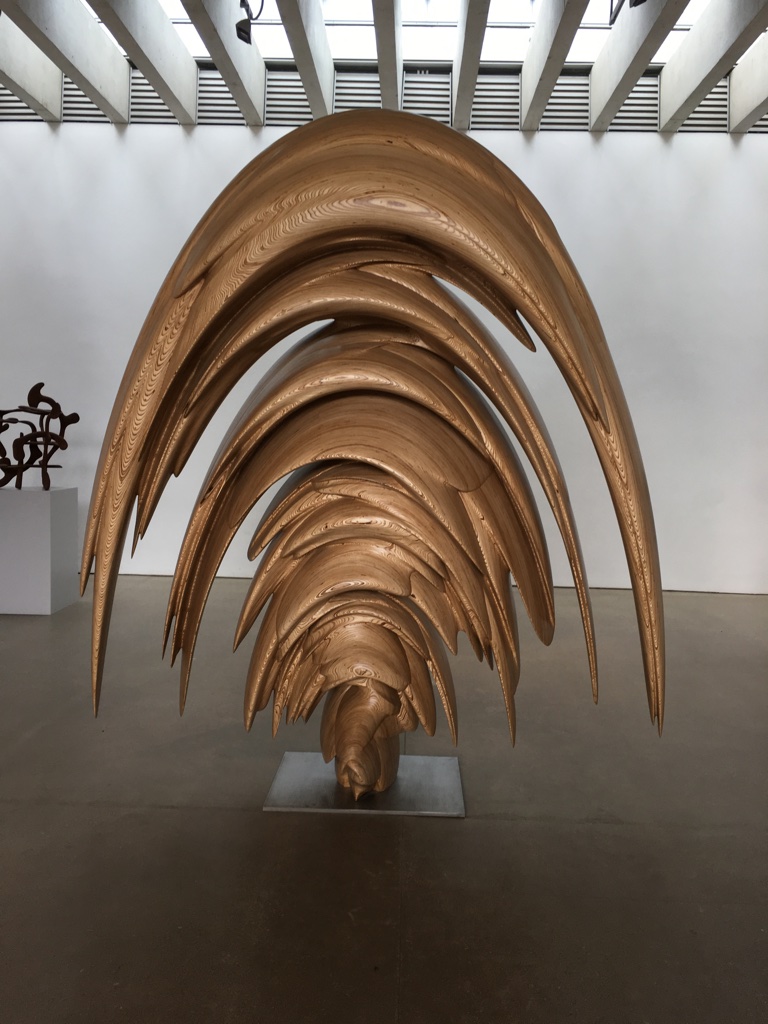
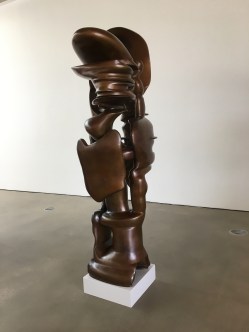
Structured as if in a Tony Cragg creation,
The outer layer speaks, yet conceals what lies within,
Layer concealing layer, strata with its own timeline,
it’s own meaning, making a concealed contribution to the Whole.
What is it I fail to grasp? What moves just beyond my perception?
When I reach out to touch, what is it that moves away?
Elusive as a butterfly darting in the mind, one moment illuminated,
The next hidden, only the question remains, what lies below?
Below my ordinary perception, below the superficiality that surrounds,
Layer below layer, atom forming structure, concealing the quantum mystery,
Mystery wrapped within enigma. Is perception possible? Is it all an illusion?
Or instead, tantalising glimpses of the layers below?
Myth and legend swirl, concealing tradition and history,
One generation follows another, some forgetting, a few retaining,
Knowledge, understanding, but fast diminishing, leaving only distorted echoes,
Of what was once crystal clear. Now lost, only the faintest echo, sounds in the void.
What was there at the edge of my perception? In the dreaming swirl that comes,
As morning dawns, when the mind hovers between the clarity of the day and the dreamy mists of the night.
A glimpse perhaps of the hidden seams concealed within the mind? The magicians who move amongst the unseen layers?
Who make, form, breathes life into the mystery that is hidden? Come the dawn, the vision fades, grows faint, and only a diminishing echo remains.
Creation.
I was fascinated by the way that Tony Cragg fashioned his sculptures. Beneath each layer, he places another layer, sometimes apparently unconnected with what went before, sometimes crafted by one of Tony’s assistants.
A different set of hands, eyes, meaning. Without seeing the creation from beginning to end in some kind of god-like way, how can anyone know the layers beneath the layers?
Know, let alone understand, what lies below? What is intended even? Just as we view a tree, not seeing the roots, the flow of the sap, the earth and air connections, and beneath all, the swirling movement of the Universe that embrace it and us.
(Tony Cragg is a British born sculptor who now lives in Germany. He is known for his exploration of unconventional materials, including plastic, fibreglass, bronze, and Kevlar. According to Art World, Craggs’ sculptures embody a frozen moment of movement, resulting in swirling abstractions.
Night
I went to bed full of love and mystery and journeyed on the wings of Morpheus. Far , far beyond the towers of Avalon and the walls of Babylon. Then down I plunged into the layers of reality that lie beneath our perception, concealed strata that sometimes boil and ripple, but more often are quiet and just whisper to the soul, Look, and you will see me, listen and you will hear me.
Nightfall
Night falls, moon rises,
Owl wakes, fox stirs,
Tiny prey, fearfully forage,
All feed, some survive.
Comes the day, departs the dark,
Sun’s warming rays, banish fears of the night,
On green meadows, flocks safely graze,
Protected by the light, yet fearful of the night.
Dusk comes, darkness looms,
Feared hunters, fearful prey,
Night stirrings, dark destruction,
The pattern, repeats, repeats.
Julian’s Bower is a turf maze found in Alkborough in North Lincolnshire. Unusually there is a carving of the maze in the stone floor of the porch of the nearby church. (There is also a copy on the East window of the church, and on a gravestone in the nearby cemetery).
As the photo shows, the view from the maze is stunning, and on a fine day reveals the countryside for many miles around. But why a maze, and what purpose did they serve?
The idea of the maze goes back as far as the legend of Theseus and the Minotaur. Theseus, son of King Aegeus of Athens. He used a ball of wool given to him by Ariadne to mark his way through the labyrinth of the Minotaur in Crete, where he slayed the monster and retraced his steps with the aid of the thread and so to safety.
Perhaps the best theory is that this maze was carved by a small cell of monks who lived in the area until the 13th century, and that it represents the path through life to heaven. This would fit in with the carving in the porch of the church.
It is also thought that mazes were also used for penitential purposes, so sinners would be made to trace the path upon their hands and knees. Yet another theory is that mazes were a way to confound the Devil, who could only travel in straight lines.
Turf mazes are all unicursal, that is, they have no choices or branches, and there are a number still to be found across England. The dates for their creation are all guesses, since because they are turf, they have to be renewed frequently, or they disappear, as many presumably have.
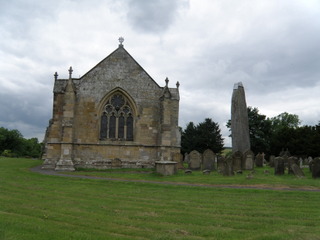
It is both surprising and stunning. As you come around the edge of Rudston church, there is the monolith, the tallest in England at 7.6 metres, with reputedly the same length buried under the ground. It is so unexpected that the stranger can only stop and admire. Of course, it predates the church by many thousands of years, and it’s presence says something very clearly. This is a holy site and has been for millennia. It is one of many henges, standing stones, circles and tumulus that still litter the landscape, that speak of a past now lost to us. Their silent witness tells of people who cared enough to put a huge effort into constructing and erecting monoliths such as this one. But why? We can only speculate. Speculate not only about the purpose, though that is grand enough. But who organised the fetching of the stone that forms it? Who fed the labourers, who had the knowledge and skill to erect a structure that has lasted thousands of years? They clearly had the leadership, resources and commitment not out of place in a modern company. Reflect on the fact that the monolith weights some 26 tons, and was transported a distance of 10 miles to its present site, and ask yourself the question, how far have we really progressed today?
Namaste is such a wonderful term. It recognises the soul that dwells within each of us, and the journey from birth to death that we all of us must make. Yet it is so difficult to see the soul in another. It is masked by our perceptions, and by how the other chooses to show themselves. Are they arrogant, self-centered maybe, a braggart, or perhaps good company, honest and caring? They too will have been fashioned by the vicissitudes of life, for better or for worse, which also shapes the face we present to the world.
But it is you and I who decides what to see, how to judge the “other” stood before us. And it is so difficult to move beyond our perceptions.
And this is the challenge. Namaste, to see the soul in another, to see underneath the surface. That does not mean to accept arrogance, or misogyny, or wrong doing, but to remember that, within that persona, there is another soul there, making their way along the same road that you follow.
Writing “The Wisdom of Rhiannon” was a test of my beliefs. I was trained as a physicist which fashioned me to see the physical world in which we live in a certain way. So I was challenged in trying to determine what “powers” did the Druids have; any, or was it trickery, or a good knowledge of the natural world, for example, in predicting eclipses? What was the nature of ancient knowledge? Certainly there is evidence of quite remarkable medical knowledge, for example, trepanation, a delicate surgical technique for making a hole in someone’s skull, with evidence that the technique dates back as far as 6500 BC, with plenty of people recovering from the operation.
And this was my difficulty. How did ancient peoples “know” what to do, let alone the Druids? Where did their knowledge come from? And what was the extent of it? My scientific training taught me that observation, experimentation, theory, and more experimentation were the only ways to classify and understand the world. But then there are people like Rupert Sheldrake, a scientist, who talks about morphic resonance, fields which reverberate and exchange information within a universal life force.
Could the Druids, amongst others, “know” when to trepan, could they “know” which herbs to collect, how to prepare medicines from them, see into the future, could they perform “magic”? But at that time I decided this was a step too far for my rational mind, so the Druids in my book are broadly simply clever people who are well read and educated.
And I think I was wrong!
If I had read Elizabeth Lloyd Mayer’s book, Extraordinary knowing: Science, Skepticism, and the Inexplicable, I would have changed my mind, just as she was forced to change hers, moving from a hard scientific paradigm to a much more open minded view. In a book full of challenging examples to the rational of conventional science, there was one example I really liked. The very successful brain surgeon who waited by the head of the patients he was scheduled to operate on until he “saw” a white light; it might take minutes, or hours, but when he saw the light, he knew his operation would be successful. His difficulty was, how to teach the technique to medical students and other surgeons, so he didn’t, because he would have been laughed at, ridiculed, after all, everyone knows that medical science doesn’t work like that!
I based a chapter in my book, the Wisdom of Rhiannon, on the famous book by Eugen Herrigel, Zen in the Art of Archery. As a Western visitor to 1930’s Japan, and a lecturer in Philosophy, Herrigel found it almost – but not quite – impossible to learn the Way of the Archer.
It involves not using the mind, not taking aim, but instead stilling the mind, holding the bow steady until “it”, as Herrigel’s teacher called it, determined when to let the arrow fly. At that point, and only at that point, did the archer, the arrow, and the target become one. To Herrigel’s frustration, his attempts to hit the target by improving his technique, the strength in his bow arm, and his concentration, all failed and only resulted in his Master’s increasing ire. Always the guidance was to wait until “it” determined when the arrow should be released.
And then comes this passage toward the end of the book:
“Do you now understand,” the Master asked me one day after a particularly good shot, what I mean by “It shoots”, “It hits”?
“I’m afraid I don’t understand anything more at all,” I answered, “even the simplest things have got into a muddle. Is it “I” who draws the bow, or is it the bow that draws me into the state of highest tension? Do “I” hit the goal, or does the goal hit me? ….. Bow, arrow, goal and the ego , all melt into one another, so that I can no longer separate them. And even the need to separate has gone. For as soon as I take the bow and shoot, everything becomes so clear and straight-forward, and so ridiculously simple ..”
Until one is committed, there is hesitancy, the chance to draw back. Concerning all acts of initiative (and creation), there is one elementary truth, the ignorance of which kills countless ideas and splendid plans: that the moment that one definitely commits oneself, then Providence moves too. All sorts of things occur to help one that would never otherwise have occurred. A whole stream of events issues from the decision, raising in one’s favour all manner of unforeseen incidents and meetings and material assistance, which no man could have dreamed would have come his way. Whatever you can do, or dream you can do, begin it. Boldness has genius, power and magic in it. Begin it now.
It didn’t even warrant the title “stream”, trickle was a more apt description for the small outflow of water running over a few rocks and surrounded by a mantle of mud. I trod warily, trying to avoid the soft, sticky mire, distracted also by the number of items hanging from the trees surrounding the water. I found myself constantly looking up into their branches, which were hung with a panoply of teddy bears, ribbons of all descriptions, and a host of small trinkets and mirrors that glittered as they spun in the breeze and caught the sunlight.
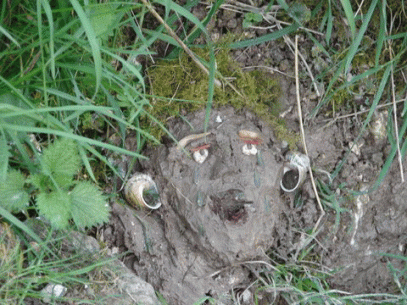
The mystery face.
So it was an unexpected discovery. There at the source of the spring, was a face. It stopped me in my tracks, and for a moment I wondered if I was really alone, the face seemed to have been so recently created. As I looked harder, I saw the two green leaves that represented tears and felt the pain that seemed to emanate from it. I wondered who had created it, and what it meant to them, and I hoped that it represented a turning point, a transition that led to light and love. I stood there for a long time, feeling the mystery of the face, wondering about its creator, caught also by the ancient spirit of my surroundings, a place that felt outside of time. Of my time anyway.
I returned to that place a few times during the week that I spent holidaying nearby. I learnt that it was a place of healing, with a history that went back thousands of years, before Roman feet walked the land, and that somehow, the knowledge of its power had not been lost, and some still visited it.
On my visits, I never did see anyone else at this sacred site, although there was always a feeling, a feeling of awareness of a – I have no word for it – a presence.


 Creation.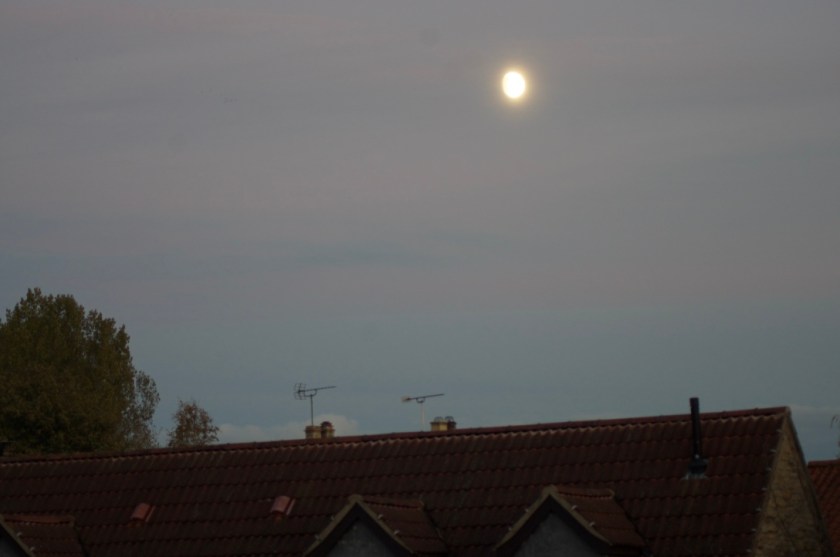


 Reflections on life in Poetry and Prose.